PIXE and XRF on Mars

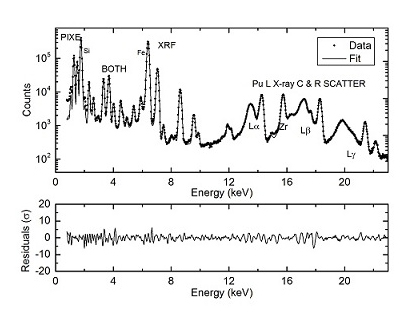
Bottom; residuals of the fit
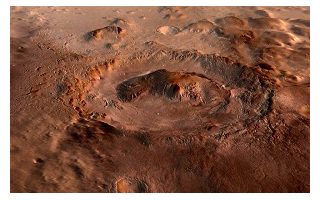
The Mars Exploration Rovers Spirit and Opportunity which attracted worldwide attention for their exploits and discoveries after 2004 each carry a Alpha-particle X-ray Spectrometer (APXS). Opportunity still functions at Meridiani Planum and in 2012 it was joined by Curiosity in Gale Crater, where exciting sedimentary deposits are being studied with strong evidence emerging for past water bodies.
The APXS contains a 244Cm source which excites X-ray emission in situ from Martian rock and soil samples, together with a small silicon drift detector which produces the X-ray spectra. There are two modes of excitation: the alpha particles from the 244Cm decay cause a variant of PIXE: and the L X-rays from the plutonium daughter cause X-ray fluorescence (XRF). Fortunately, this variant of PIXE has its greatest sensitivity for the lightest elements (Na - Ca) whereas XRF is best for the heavier elements (Ca - Zr). As a result, the APXS has excellent sensitivity all the way across the range of elements that occur in most minerals and rocks.
Starting from our proven GUPIX software we developed a fundamental parameters approach to fitting APXS spectra and extracting element concentrations; this is GUAPX. We also developed, starting from our GUYLS code, the software APX-Yield for predicting X-ray yields from given element concentrations (i.e. the inverse problem).
Recently we made major improvements to GUAPX to improve the accuracy of the fitted ratio C/R of the Compton and Rayleigh scatter peak intensities, which can be used to estimate the content of 'invisible components' such as water and carbonate (Paper 225). The new work is described in papers 241 & 255. In the GRM GL-O with 6.4 wt% water we measure 6.9±1.5wt%. Further improvements to fit quality have been accomplished through a new systematic approach to detector non-linearity and incorporation of multiple ionization satellites (papers 258 & 264).
APX-Yield had its first application in probing the thin reddish film that appeared on Curiosity's basalt calibration target after landing on Mars (paper 250) amid a cloud of pulverized Martian dust and soil. The calibration target had undergone major changes relative to that measured in Guelph. We showed that the film was about 100 nm thick, containing predominately MgO, Fe2O3, SO3, Cl. This was thin enough that if present on the sensor head it would not cause worsening of accuracy. APX-Yield was next used on Mars to analyze samples deposted on the APXS calibration tray. The first sample was soil at the Rocknest site, sieved and deposited on thetray (paper 247); the second was wind-blown dust accumulated on the tray (paper 256).
A variant of APX-Yield was employed in G. M. Perrett's thesis work to predict quantitatively the mineral phase effects on APXS-determined element concentrations in GRMs. Good agreement with measured effects was found. This laid the groundwork for the senior undergraduate project of J. Van Bentham who used the same software to predict mineral phase for a variety of feldspar-olivine-pyroxene-etc mixtures.
APX-Yield also presents the possibility to characterize thin films of material on the Martian substrate rocks. We have completed a project with Brock University partners within the APXS team where we study Curiosity samples before and after application of the dust removal tool (DRT). The Brock partners determine the fractional dust coverage before and after DRT; with these numbers APX-Yield then determines the dust thickness and its element concentrations. The latter agree well with earlier analyses of dust on the APXS observation tray. Currently we are changing the code to assume the latter concentrations and derive the substrate concentrations, thereby removing much of the error in light element concentrations caused by surface dust.
Finally, see the NEWS sections for current work with the new broad-beam PIXE system which emulates APXS in our lab and is being used to refine the APXS calibration and better understand the influence of the inevitable mineralogical heterogeneity of rock samples upon analytical accuracy.